

Are you importing Fresh Onions or Amla Powder from India? Confused between FOB and CIF? Read this guide by Regal Impex to choose the right Incoterm for your business and save on logistics costs.
If you are new to the world of international trade, the jargon can often feel overwhelming. When you request a price quote for Fresh Onions or Amla Powder from an Indian exporter like Regal Impex, you will typically see three letters next to the price: FOB or CIF.
These are Incoterms (International Commercial Terms), and they determine who pays for what during the shipping process. Choosing the right one can save you hundreds of dollars per container and save you from improved logistics headaches.
Here is a simple breakdown to help you decide which is right for your next order.
1. What is FOB (Free On Board)?
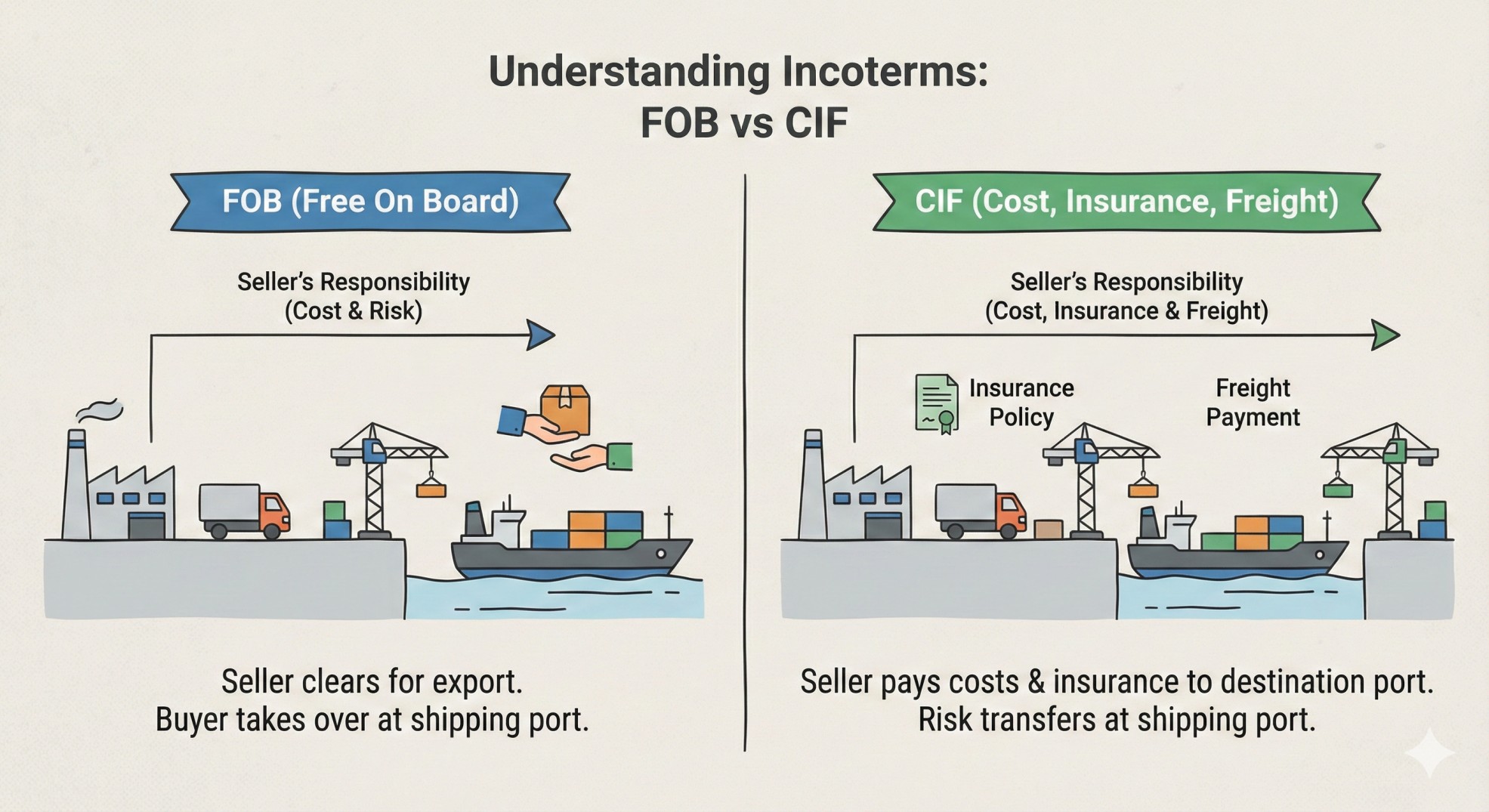
In an FOB agreement, the seller (Regal Impex) is responsible for the goods only until they are loaded onto the shipping vessel at the Indian port (e.g., Nhava Sheva or Mundra).
- Our Responsibility: We pack the goods, transport them to the port, and handle Indian export customs clearance.
- Your Responsibility: Once the goods are on the ship, you pay for the ocean freight, marine insurance, and arrival procedures.
✅ Choose FOB If:
- You have a trusted freight forwarder who gives you great shipping rates.
- You want full control over the shipping schedule and route.
- You are an experienced importer.
2. What is CIF (Cost, Insurance, and Freight)?
In a CIF agreement, the seller (Regal Impex) covers the costs to get the goods to your destination port.
- Our Responsibility: We handle packing, transport, Indian customs, Ocean Freight charges, and Marine Insurance.
- Your Responsibility: You simply wait for the goods to arrive at your port, then handle the unloading and import duties.
✅ Choose CIF If:
- You are a new importer and don’t want to deal with shipping lines.
- You want a “hassle-free” price where logistics costs are already calculated.
- You want to lock in the shipping price to avoid fluctuations.
Here is the detailed, SEO-optimized Blog Post version of the Incoterms topic. This is designed to be published on the Regal Impex website.
I have included an image prompt suitable for a blog header (landscape format) and social media sharing.
Blog Post Image
Prompt: A high-quality, professional image of a shipping container ship at a busy port during sunset, with a subtle overlay of a digital logistics map or icons representing ‘Insurance’ and ‘Freight’. The style should be corporate and clean, suitable for a B2B export business blog header. Aspect ratio 16:9.
Blog Title: FOB vs. CIF: Which Shipping Term is Best for Importing Food Products from India?
Meta Description: Are you importing Fresh Onions or Amla Powder from India? Confused between FOB and CIF? Read this guide by Regal Impex to choose the right Incoterm for your business and save on logistics costs.
Article Body
If you are new to the world of international trade, the jargon can often feel overwhelming. When you request a price quote for Fresh Onions or Amla Powder from an Indian exporter like Regal Impex, you will typically see three letters next to the price: FOB or CIF.
These are Incoterms (International Commercial Terms), and they determine who pays for what during the shipping process. Choosing the right one can save you hundreds of dollars per container and save you from improved logistics headaches.
Here is a simple breakdown to help you decide which is right for your next order.
1. What is FOB (Free On Board)?
In an FOB agreement, the seller (Regal Impex) is responsible for the goods only until they are loaded onto the shipping vessel at the Indian port (e.g., Nhava Sheva or Mundra).
- Our Responsibility: We pack the goods, transport them to the port, and handle Indian export customs clearance.
- Your Responsibility: Once the goods are on the ship, you pay for the ocean freight, marine insurance, and arrival procedures.
✅ Choose FOB If:
- You have a trusted freight forwarder who gives you great shipping rates.
- You want full control over the shipping schedule and route.
- You are an experienced importer.
2. What is CIF (Cost, Insurance, and Freight)?
In a CIF agreement, the seller (Regal Impex) covers the costs to get the goods to your destination port.
- Our Responsibility: We handle packing, transport, Indian customs, Ocean Freight charges, and Marine Insurance.
- Your Responsibility: You simply wait for the goods to arrive at your port, then handle the unloading and import duties.
✅ Choose CIF If:
- You are a new importer and don’t want to deal with shipping lines.
- You want a “hassle-free” price where logistics costs are already calculated.
- You want to lock in the shipping price to avoid fluctuations.
Comparison: At a Glance
| Feature | FOB (Free On Board) | CIF (Cost Insurance Freight) |
| Ocean Freight Paid By | Buyer (You) | Seller (Regal Impex) |
| Insurance Paid By | Buyer (You) | Seller (Regal Impex) |
| Risk Transfer Point | When goods are loaded on the ship in India | When goods are loaded on the ship (Cost is paid by seller, but risk transfers early) |
| Best For | Experienced Buyers | Beginners / Convenience Seekers |
Export to Sheets
Conclusion: Which is right for you?
At Regal Impex, we believe in flexibility. Whether you are sourcing our premium Nashik Red Onions or organic Amla Powder, we can provide quotations in both FOB and CIF terms.
If you are unsure, we recommend starting with CIF for your first shipment to ensure a smooth delivery process. Once you are comfortable with the volume, you can explore FOB to optimize costs.
Ready to place your order? Contact us today for a competitive quote.
Contact Us:
- Website: www.regalimpex.com
- Email: regalimpex08@gmail.com

